Deeper, sediment-rich rocky habitat, also occurring over sandy patches
between rocks.
Geographic distribution:
Restricted to the eastern coast of Lake Malawi, where it occurs between
Lupingu and Manda.
Sexual dimorphism:
Males and females are similar in general body shape, with an elongate form.
Females are dark brown in coloration, similar to females of
Maylandia sp. ‘zebra gold’. Both sexes usually occur singly.
Diet:
Plankton is commonly available at depths of approximately 15–25 meters, and
this species is associated with habitats where plankton feeding is common.
It also forages from the biocover on rocky substrates.
Breeding:
Spawning behavior has not been described separately for this species, but it
occurs in deeper rocky habitats similar to those inhabited by
Maylandia sp. ‘zebra gold’, where spawning typically takes place in caves
among rocks or in excavated pits beneath stones.
Aggression:
No specific observations are provided. By comparison with closely related
species from deeper rocky habitats, aggression is likely directed primarily
towards conspecifics.
Special notes:
Maylandia sp. ‘zebra yellow tail’ is considered similar and possibly
closely related to Maylandia sp. ‘zebra gold’, but differs clearly in its
geographic distribution. While M. sp. ‘zebra gold’ is restricted to the
western coast of Lake Malawi, M. sp. ‘zebra yellow tail’ is confined to the
eastern coast. Polychromatism has not been observed in this species.
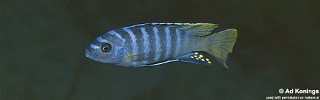
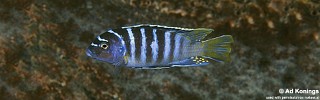
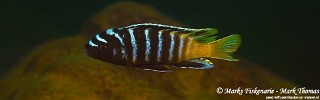





Photo gallery