Rocky habitat, usually sediment-free and often in very shallow water, but also
occurring at somewhat deeper levels on rocky shores with moderate sediment.
Requires exposed rock surfaces for aufwuchs growth and caves for shelter and
spawning.
Geographic distribution:
Lake Malawi, occurring around the Maleri islands (Maleri, Nakantenga, and Nankoma),
at Chidunga Rocks, and at Kanchedza Island.
Typical adult size:
In the wild males reach about 13 cm total length and females about 11 cm. In aquaria
males may grow considerably larger, occasionally up to around 18 cm.
Sexual dimorphism:
Males are light blue to sky-blue with 7–9 indistinct bars and a yellow gular and chest
region; fins are pale blue with a yellow-tinged margin and the anal fin bears yellow
ocelli. Females are dark brown to blue-gray with pale brown-gray fins and lack the
bright coloration of males.
Recommended aquarium size:
At least 300 liters for long-term maintenance.
Aquarium setup:
Provide a rocky layout with multiple caves and shelters. Each species in the aquarium
should have access to its own hiding or spawning site. Avoid keeping more than one
adult male in the same tank.
Diet:
Omnivorous with a strong reliance on aufwuchs. Feeds mainly on diatoms and loose
strands of cyanobacteria combed from rocky substrates, but also consumes plankton
and small invertebrates.
Breeding:
Breeding males defend territories centered around a cave among rocks. Territories are
usually widely spaced due to low population density. Spawning takes place inside
the cave. Females are maternal mouthbrooders and release the fry after about three
to three and a half weeks.
Aggression:
Can be aggressive within the species, especially between males, but is generally
tolerant toward other mbuna species of similar size and temperament.
Special notes:
This species belongs to the group of so-called large zebra cichlids and shows a
patchy distribution across Lake Malawi.
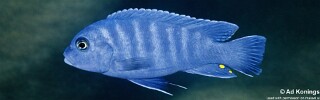
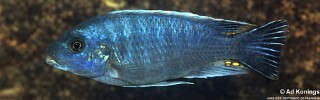






Photo gallery