Maylandia zebra 'Thumbi East Island' Metriaclima zebra 'Thumbi East Island'
Genus:
Maylandia
Type locality:
Likoma Island, Lake Malawi, Malawi
Biotope:
Rocky habitat largely free of sediment, typically at depths between 5 and 10 meters.
The species is strictly associated with rocks that provide shelter and spawning
sites.
Geographic distribution:
Widespread in Lake Malawi, occurring from Cape Manulo to Kande Island, around
Namalenje Island, the Nankumba Peninsula, Boadzulu Island, and from Makanjila Point
to Mala Point. It is also found from Mbamba Bay to Lundu, from Lumbila to Ikombe on
the eastern shore, around Likoma Island, and at Taiwanee Reef.
Typical adult size:
In the wild, males usually reach about 12 cm total length, while females are
typically 1–2 cm smaller. In the aquarium, both sexes can grow several
centimeters larger than in nature.
Sexual dimorphism:
Males are blue with distinct black vertical bars, while females are never blue and
show various shades of beige to brown. Females are also noticeably smaller than
males.
Recommended aquarium size:
A minimum aquarium volume of about 400 liters is recommended, with a minimum tank
length of approximately 140 cm.
Aquarium setup:
The aquarium should contain abundant rockwork with numerous hiding places to mimic
the natural rocky habitat. It is recommended to keep one male with at least three
to four females, or in larger groups. Due to its strong temperament and high
aggression, it is best kept with other robust, algae-grazing mbuna species to help
distribute aggression.
Diet:
Primarily herbivorous and classified as an algae-grazing mbuna. It feeds mainly on
diatoms and other algae from the aufwuchs, but it is not a strict aufwuchs
specialist and also feeds on plankton in the water column.
Breeding:
Breeding males defend territories centered around caves among the rocks, often at the
base of large boulders. Territories usually border one another closely. Females
form foraging schools but spawn individually inside the male’s cave. Females are
maternal mouthbrooders and usually hide among the rocks while incubating eggs and
fry.
Aggression:
Highly aggressive and territorial, especially males. Aggression is pronounced both
within the species and toward other species, although females are generally less
aggressive.
Special notes:
This is the classic “Zebra Cichlid” and one of the most widespread and variable mbuna
species in Lake Malawi. Numerous geographical variants are known, including forms
such as the so-called Blue Blaze Zebras from the northeastern part of the lake.
Despite its variability, it is one of the most common and well-established mbuna
species in both the wild and the aquarium hobby.
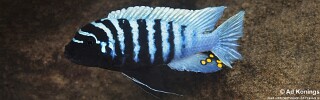






Photo gallery