Very shallow intermediate habitat, found at depths no greater than
about 3 m; males defend holes dug under and between rocks.
Geographic distribution:
Only known from the southeastern coast of Lake Malawi in
Mozambique, around Nkolongwe.
Typical adult size:
Around 10 cm total length.
Sexual dimorphism:
Males are larger than females, with broader fins and larger anal
ocelli; males are plain sky blue, while females are duller grey-blue.
Diet:
Anterior tooth shape indicates adaptation to algae pulling; likely
feeds mainly on aufwuchs and possibly small invertebrates. In
captivity, feeding should be sparing and mainly herbivorous to
prevent obesity and intestinal disorders.
Breeding:
Maternal mouthbrooder; eggs and fry are incubated for about
3 weeks, with release occurring within
about one week depending on conditions.
Aggression:
Strongly territorial; males actively chase conspecific intruders
from their territories, though generally less dangerous to tank
mates than some other highly aggressive mbuna.
Special notes:
Recognizable by the plain sky-blue coloration of adult males and a
stretched, rectangular body profile. Differs from the zebra complex
by body shape and from Pseudotropheus socolofi by a broader
mouth and strongly concave snout. Jaws are strong and protruding,
bearing densely set bicuspid teeth; males show a yellow-orange
hint on the throat.
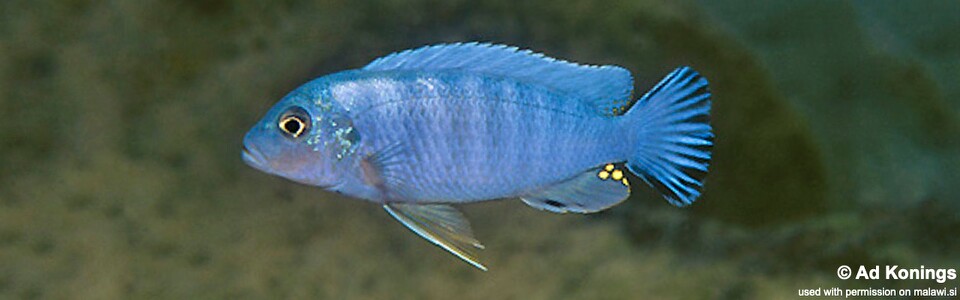



Photo gallery