Intermediate habitat dominated by sand with a few sediment-covered rocks; females forage close to the bottom, territorial males usually occur deeper
Geographic distribution:
Endemic to the Mbenji Islands and Nkhomo Reef, Lake Malawi
Typical adult size:
Males up to ~15 cm in the wild (rarely approaching ~18 cm in aquarium); females up to ~10 cm
Sexual dimorphism:
Females beige-silvery with three black lateral spots. Mature males larger and deep azure-blue, with flank spots largely obscured
Recommended aquarium size:
Minimum tank length: ~100 cm for a pair; larger tanks (400 litres / 150 cm) are recommended for a harem and to observe natural behaviour.
Aquarium setup:
Provide ample open sand with a few rocks/flat stones for territorial reference and bower construction; strong filtration with very clean water but avoid excessively strong current. Best kept with one adult male and multiple females
Diet:
Plankton and benthic invertebrates taken close to the sandy bottom, typically within a couple of meters of the substrate
Breeding:
Maternal mouthbrooder; males defend sand bowers around/under rocks, typically at ~19–25 m depth. Bowers are commonly 19–33 cm in diameter and spaced several meters apart
Aggression:
Territorial males strongly aggressive to rival males; generally peaceful toward non-similar tankmates
Special notes:
Member of the Copadichromis mbenjii group; females show three lateral spots while males in breeding dress have a blue breast and a narrow yellow marginal band in the anal fin. Avoid keeping with very similar-looking species such as C. insularis to reduce aggression and hybridisation risk
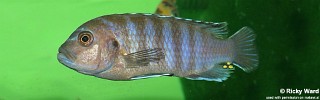
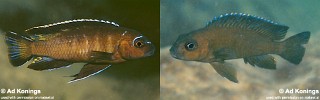
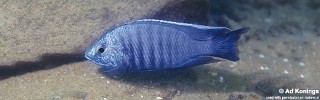

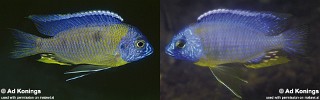



Photo gallery