Restricted to rocky shores and intermediate sandy areas where rocks are covered by a layer of sediment.
Geographic distribution:
Lake-wide distribution, with remarkably little geographical variation.
Typical adult size:
Attains about 15 cm in males and 12 cm in females in the wild.
Recommended aquarium size:
An aquarium of at least 300 l with a minimum length of 1.3 m is required to keep and breed one dominant male with several females.
Substantially larger aquaria are necessary if more than one male is kept.
Aquarium setup:
Provide rocks and a sandy substrate to allow natural feeding behavior and to offer hiding places, particularly for mouthbrooding females.
Diet:
Feeds by blowing water into the sediment and picking uncovered prey items.
Diet consists mainly of insect larvae and crustaceans.
Juveniles of sand-dwelling cichlids are often attracted to the stirred-up sediment.
Breeding:
Males excavate shallow spawning pits in sand between stones and rocks.
Females spawn on the male’s platform and collect the fertilized eggs in their mouths.
Mouthbrooding lasts two to three weeks, and females continue to guard the fry after release.
Average broods comprise about 35 fry.
Special notes:
Distinguished by strongly marked longitudinal and vertical black stripes, fleshy lips partly obscuring posterior upper-jaw teeth,
and relatively few gill rakers with blunt anterior elements. Known in the aquarium trade as the “Steveni Thick Bars”.
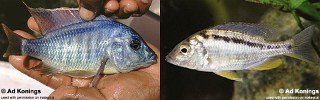
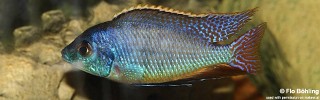
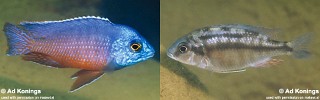
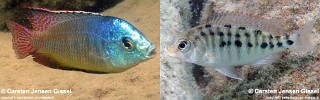



Photo gallery