Areas of small and medium-sized rocks, also occurring on sandy patches
among rocks; most numerous between 5–15 m depth, with a depth range
extending from the extreme shallows to at least 25 m.
Geographic distribution:
Occurs along the northeastern shore of Lake Malawi between Ngara and
Cape Manulo in Malawi.
Typical adult size:
Males up to about 8 cm total length; females up to about
6.5 cm total length.
Sexual dimorphism:
Males are usually light to sky-blue, sometimes with varying amounts of
yellow on the anterior part of the body; females are brown to very
light beige-blue, often with distinct vertical barring.
Recommended aquarium size:
An aquarium volume of about 250 l or a minimum tank length of
100 cm is recommended; aquaria larger than 400 l or longer than
150 cm are required if more than one male is to be kept.
Aquarium setup:
Provide ample hiding places among rocks and use fine-grained substrate,
preferably sand, to allow males to excavate burrows. Maintain pH
between 7.0 and 8.5 and keep temperature between 23 and 28 °C.
Avoid combining with species that closely resemble males in breeding
coloration, as this may increase aggression.
Diet:
Feeds on aufwuchs, picking algae from small pockets in rocks that are
inaccessible to larger herbivores; diet consists almost entirely of
blue-green algae (cyanobacteria) with a very small proportion of
invertebrates.
Breeding:
Males are territorial year-round, defending a small cave among rocks and
feeding within their territory. Females are non-territorial and are
maternal mouthbrooders that retreat among rocks to release the fry.
Aggression:
Males are almost permanently territorial and should not be kept with
more than one male in smaller aquaria.
Special notes:
The species shows considerable geographical variation in
male coloration. The holotype has a relatively large eye (about 35% of head length), a feature not fully
matched by all known populations currently assigned to this species.
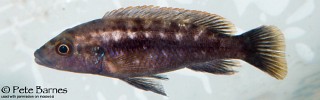
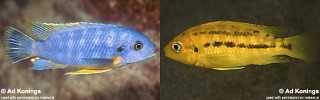
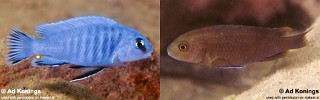
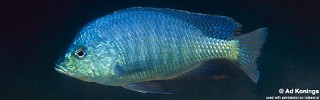
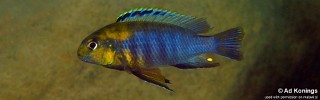



Photo gallery