Pelagic, open-water habitats; large offshore predator most frequently
inhabiting the open water column.
Geographic distribution:
Reported lake-wide in Lake Malawi, occurring in inshore reef and shelf
zones as well as offshore in the true pelagic zone, at depths of
8 to 121 m.
Typical adult size:
Up to about 388 mm standard length; among the largest
Rhamphochromis species in overall bulk.
Sexual dimorphism:
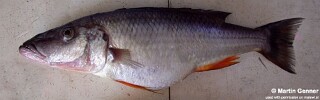
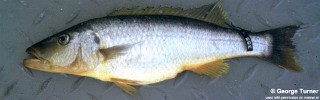
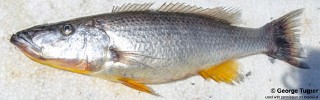
Breeding males exhibit orange pelvic fins and a solid orange anal fin
without eggspots. The branchiostegal membrane is typically orange
and may extend onto the chest, belly and lower operculum. Males
retain strong countershading rather than turning uniformly silver.
Diet:
Piscivorous. Larger individuals feed mainly on pelagic fishes
including Diplotaxodon spp. and
Engraulicypris.
Breeding:
Maternal mouthbrooder. Smallest recorded ripe male
164 mm standard length; smallest ripe female
198 mm standard length. Ripe females may carry
up to 546 eggs measuring nearly 5 mm in diameter.
Mouthbrooding females recorded in midwater at
30–50 m depth.
Special notes:
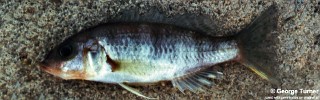
A very large ncheni with a deep, laterally compressed head,
extremely large mouth with hard non-fleshy lips, long lower jaw,
and huge, widely spaced teeth. The premaxillary pedicel is long
and generally does not protrude markedly posteriorly. Unlike some
other large congeners, males do not develop a distinct horizontal
dark stripe.
Taxonomic history within the genus has been highly confused, with
extensive historical misidentifications in museum collections and
overlapping diagnoses in earlier revisions. Current interpretation
treats R. brevis as a junior synonym of
R. woodi. It ranks among the four largest
Rhamphochromis species in Lake Malawi and is
probably second in overall size.
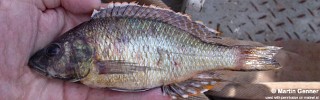



Taxonomic history within the genus has been highly confused, with extensive historical misidentifications in museum collections and overlapping diagnoses in earlier revisions. Current interpretation treats R. brevis as a junior synonym of R. woodi. It ranks among the four largest Rhamphochromis species in Lake Malawi and is probably second in overall size.
Photo gallery