Sediment-rich intermediate habitat at the transition between sand and rock.
Occurs mainly at depths between 7 and 15 m, but has been recorded from shallow areas down to approximately
27 m.
Geographic distribution:
Widely distributed in the southern part of Lake Malawi on both eastern and western shores.
Recorded from Nakantenga Island, Mbenji Island, the Maleri Islands, Chidunga Rocks, Chimwalani (Eccles) Reef,
and Luwala Reef, extending south to Nkhudzi Headland and Mazinzi Reef.
A single historical record exists from Thumbi West Island, but the species has not been confirmed there
subsequently.
Typical adult size:
Adult males usually reach about 10–12 cm, with females remaining slightly smaller.
In aquaria, individuals may grow to approximately 13 cm.
Sexual dimorphism:
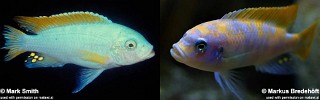
Sexual dimorphism is pronounced.
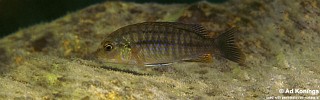
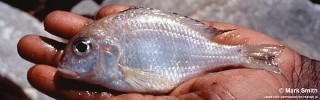
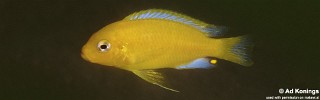
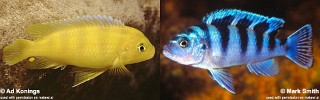
Adult males are golden yellow, while females are beige to light brown.
Females may darken slightly while mouthbrooding, but yellow mouthbrooding females have not been observed
in the lake.
Recommended aquarium size:
300 L.
Aquarium setup:
Provide a combination of rocky structures with numerous hiding places and open sandy areas.
A minimum tank length of 120 cm is recommended.
Stock at least 3–4 females per male to reduce intraspecific aggression.
Suitable tankmates include other herbivorous mbuna from genera such as Cynotilapia,
Melanochromis, Maylandia, Pseudotropheus, and Tropheops.
Diet:
Herbivorous.
In nature it feeds primarily on algae scraped from rocks, but also consumes zooplankton in open areas,
especially in sediment-rich habitats.
In the aquarium, offer vegetable-based foods supplemented with spirulina.
Breeding:
Males are strongly territorial and excavate burrows beneath small rocks as spawning sites.
Territories may be close together, with ritualized fights between neighboring males.
Spawning occurs inside the male’s burrow; females are maternal mouthbrooders carrying relatively small
broods of approximately 10–30 eggs.
Females release the fry after about three to three and a half weeks and do not provide further care.
Aggression:
Highly aggressive within the species, particularly among males.
Generally tolerant toward other species, though aggression increases toward similarly colored males.
Special notes:
Assigned to the Maylandia aurora group, which occupies intermediate habitats in Lake Malawi.
Males lack distinct vertical bars and do not show a black stripe in the dorsal fin; the nape is yellow,
setting them apart from other members of the genus.
The anal fin of males typically bears a single large egg-spot; the color of the anal fin margin varies
geographically, being black in some populations and yellow in others.
Females closely resemble those of M. chrysomallos, and hybridization is possible in captivity.



Occurs mainly at depths between 7 and 15 m, but has been recorded from shallow areas down to approximately 27 m.
Recorded from Nakantenga Island, Mbenji Island, the Maleri Islands, Chidunga Rocks, Chimwalani (Eccles) Reef, and Luwala Reef, extending south to Nkhudzi Headland and Mazinzi Reef.
A single historical record exists from Thumbi West Island, but the species has not been confirmed there subsequently.
In aquaria, individuals may grow to approximately 13 cm.
Adult males are golden yellow, while females are beige to light brown.
Females may darken slightly while mouthbrooding, but yellow mouthbrooding females have not been observed in the lake.
A minimum tank length of 120 cm is recommended.
Stock at least 3–4 females per male to reduce intraspecific aggression.
Suitable tankmates include other herbivorous mbuna from genera such as Cynotilapia, Melanochromis, Maylandia, Pseudotropheus, and Tropheops.
In nature it feeds primarily on algae scraped from rocks, but also consumes zooplankton in open areas, especially in sediment-rich habitats.
In the aquarium, offer vegetable-based foods supplemented with spirulina.
Territories may be close together, with ritualized fights between neighboring males.
Spawning occurs inside the male’s burrow; females are maternal mouthbrooders carrying relatively small broods of approximately 10–30 eggs.
Females release the fry after about three to three and a half weeks and do not provide further care.
Generally tolerant toward other species, though aggression increases toward similarly colored males.
Males lack distinct vertical bars and do not show a black stripe in the dorsal fin; the nape is yellow, setting them apart from other members of the genus.
The anal fin of males typically bears a single large egg-spot; the color of the anal fin margin varies geographically, being black in some populations and yellow in others.
Females closely resemble those of M. chrysomallos, and hybridization is possible in captivity.
Photo gallery