Rocky habitat. Occurs mainly among large rocks in shallow water,
but is also found over sediment-rich rocky biotopes at somewhat greater
depths. Rare in areas where rocks are scattered on sandy bottoms.
Geographic distribution:
Endemic to the Mbenji Islands in the southern half of Lake Malawi.
Typical adult size:
In the lake, males reach about 13–14 cm total length, while females
remain approximately 20% smaller. In the aquarium, both sexes can grow
considerably larger, with males reaching up to about 17 cm.
Sexual dimorphism:
Mature males have a cobalt blue body and head with a bright orange
dorsal fin. Females are light brown with a yellow to orange dorsal fin.
A relatively high proportion of females occur in OB morphs; OB males
(marmalade cats) are also present.
Recommended aquarium size:
A community aquarium should contain at least 350–400 L due to the
species’ size and activity. A species tank with one male and several
females should contain at least about 200 L.
Aquarium setup:
Provide extensive rockwork with caves and crevices for shelter and
spawning sites. Sand is preferred as substrate. One male should be kept
with three to four females. Larger groups are possible in spacious
aquaria. Best kept with other robust algivorous mbuna such as
Cynotilapia, Melanochromis, Maylandia,
Pseudotropheus, or Tropheops.
Diet:
Primarily herbivorous. Feeds mainly on aufwuchs, consisting of diatoms
and small algal strands combed from rocks, but is frequently observed
feeding on plankton in the water column.
Breeding:
Maternal mouth-brooder. Males defend territories centered around caves
among the rocks, often between medium-sized stones. Spawning occurs
inside the male’s cave. Mouth-brooding females are usually solitary and
hide among the rocks; fry are released in very shallow water.
Aggression:
Aggressive within the species, especially among males. Generally
tolerant toward dissimilar mbuna species, but aggression is directed
mainly toward conspecifics and closely resembling species.
Special notes:
This species shows a notable frequency of OB females and occasional
OB males. Males recognize OB individuals as conspecifics and direct
aggression toward them. The absence of other large, unbarred
Maylandia species at the Mbenji Islands likely facilitates
mate recognition.
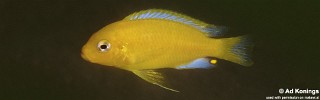
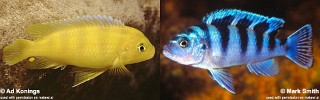
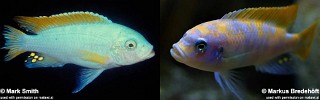
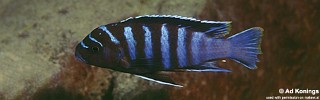
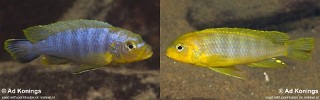



Photo gallery