Deep-water trawling grounds over a bare mud floor, typically at 80–130 m
depth.
Geographic distribution:
Southern Lake Malawi, commonly taken in trawls at 80–130 m, with records
extending at least north to Nkhotakota; few samples have been collected below
120 m.
Typical adult size:
Type series 54.5–117 mm SL; not reported to exceed 120 mm SL.
The holotype is 106.7 mm SL (about 12.5 cm total length), and the
maximum reported size is about 14 cm total length.
Sexual dimorphism:
Sexually active males become black with a coppery sheen and show a broad
white to whitish-yellow margin along the spiny dorsal fin, plus one to two large
pale yellow eggspots on the anal fin. Adult females are darker dorsally with a
dusky dorsal fin, while the anal and pelvic fins are white.
Diet:
Gut contents have included fragmented remains of insect larvae, crustaceans,
and diatoms; the upwardly angled mouth suggests feeding in the water column
rather than from sediments.
Breeding:
Reproductive activity occurs year-round, with spawning associated with
approximately 100–125 m depth; females reach sexual maturity at about
9.8 cm in length.
Special notes:
Mature males are uniformly dark in full breeding condition and show a broad
white dorsal-fin margin, while less ripe males can be paler ventrally without
developing a strongly white belly. Whole-genome data place the species in a
well-supported clade, with Diplotaxodon sp. ‘ecclesi white dorsal’ as the
sister taxon.
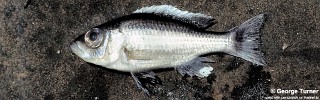

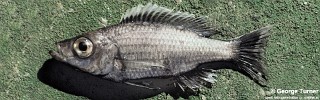



Photo gallery