Intermediate and rocky habitats, dependent on the presence
of rocks for feeding and breeding; breeding individuals are
mostly observed deeper than 15 m, while subadults and
foraging fish may occur as shallow as 2 m.
Geographic distribution:
Lake-wide distribution in Lake Malawi.
Typical adult size:
Up to about 30 cm total length; females remain only a
few centimeters smaller.
Sexual dimorphism:
During the breeding period males are blue overall, with an
anal fin that has a black base, predominantly red coloration,
and a thin yellow outer margin bearing yellow-white egg-dummies.
Females are yellow-gray with darker blotches and fine red points.
Outside the breeding season sexes are similar in appearance.
Recommended aquarium size:
A very large aquarium is required to accommodate a group of
this species.
Aquarium setup:
Keep only one adult male per
aquarium and combine with similarly sized cichlids. Provide rocky
structures and open areas; small mbuna may be taken as prey.
Diet:
Specialized predator of juvenile mbuna, extracting them from
crevices with a highly protractile mouth. It positions its
downward-projecting snout above cracks and sucks prey out by
rapidly expanding the buccal cavity.
Breeding:
Maternal mouth-brooder breeding in deep rocky habitats with
a relatively short annual breeding period. Males defend
territories only during breeding, centered on a flat rock or on
sand beside rocks, sometimes forming a simple cave-crater bower.
Spawning occurs on rock or sand near rocks; the female collects
eggs before fertilization and then sucks in the male’s sperm.
Both sexes lose most mottled markings during nuptial coloration.
Aggression:
Large predatory species; males are strongly territorial in
captivity and only one adult male should be kept per aquarium.
Special notes:
Distinguished by its unusual downward-projecting snout and
spotted pectoral fins. Resembles N. polystigma in overall
pattern but differs markedly in snout shape. Outside the breeding
season large orange spots may be visible on the anal fin, but
these disappear in both sexes during nuptial coloration.
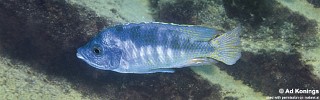
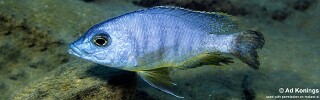
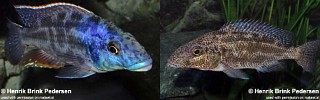
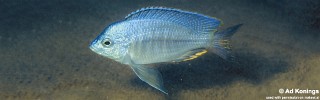
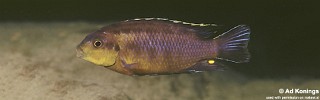



Photo gallery