Pseudotropheus sp. 'williamsi makanjila' Mbenji Island
Genus:
Pseudotropheus
Biotope:
Upper rocky and intermediate habitat in turbulent zones of Lake Malawi,
closely associated with large rocks. Recorded from the surface down to about
4 m depth, with some populations observed in less than 2 m.
Geographic distribution:
Eastern shore of Lake Malawi, excluding Tanzanian waters.
The population from Mbenji Island is included in this form.
Typical adult size:
Up to about 15 cm total length for members of this super-species.
Sexual dimorphism:
Males are more intensely colored and develop longer fins and larger ocelli,
whereas females are generally greyish brown.
Recommended aquarium size:
A tank volume preferably over 400 l is recommended. To maintain more than
one active male, a minimum tank length of around 2 m is required.
Aquarium setup:
A spacious aquarium with extensive rockwork and numerous shelters of
different sizes is required to provide territorial structure and refuge.
Strong filtration and regular maintenance are necessary, and water should
be alkaline and moderately hard, with a temperature around 25 °C.
Diet:
Opportunistic feeder relying mainly on insects and their larvae. Food items
also include zooplankton, detritus and Aufwuchs. Insects are taken at the
surface and sometimes above it, with individuals jumping out of the water
to capture prey.
Breeding:
Maternal mouthbrooder. Spawning takes place in the male’s territory with
circular movements and a T-shaped posture. Eggs are collected in the
female’s mouth and fertilized there. Incubation lasts about 3 weeks at
approximately 25 °C, and fry may remain sheltered in the female’s
mouth for about one additional week or longer.
Aggression:
Can be strongly aggressive toward conspecifics and intrusive toward less
active mbuna in community aquaria. Territorial interactions are directed
primarily at conspecific males.
Special notes:
An undescribed member of the Pseudotropheus williamsi super-species,
characterized by the absence of a pronounced submarginal band in the dorsal
and anal fins and by yellow to orange-red patches on the throat or belly.
It forms part of a complex of closely related geographic forms along the
eastern shore of Lake Malawi.
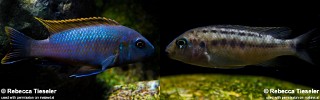
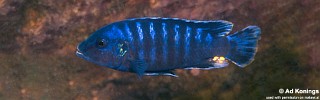
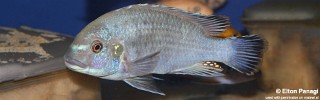
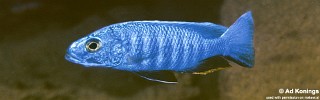
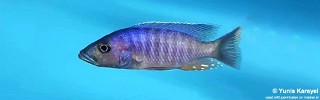



Photo gallery