Deep-water habitats over a muddy lake bottom, with records from about
80–130 m and frequent captures around 100 m.
Geographic distribution:
Recorded from the southern arms of Lake Malawi, where it is reported as common
in bottom-trawl catches from deep water.
Typical adult size:
Up to 117 mm SL (about 14 cm total length) based on confirmed material.
Sexual dimorphism:
Breeding males show strong countershading with a very dark dorsal surface,
black pelvic fins, and a dark anal fin bearing one or two pale yellow eggspots;
the dorsal fin shows a broad white margin with a contrasting darker posterior
section. Females and immatures remain more uniformly silvery and countershaded,
with white pelvic and anal fins and no eggspots; male pelvic fins are longer and
may reach the anterior margin of the genital papilla, whereas female pelvic fins
do not reach the vent.
Diet:
Stomachs examined were empty or everted, but the steeply angled gape and long
gill rakers have been interpreted as consistent with feeding on small midwater
animals such as planktonic invertebrates or fish larvae.
Breeding:
A maternal mouthbrooder with relatively small broods of large eggs; one female
was recorded carrying 17 eggs up to 5.6 mm in diameter, and ovarian
asymmetry has been noted with the right ovary larger. Reproductively active
individuals have been taken in deep bottom trawls (around 100 m), consistent
with spawning associated with deep benthic habitats, and breeding-condition fish
have been collected in February and October.
Special notes:
Breeding males are characterized by a pale underside and a broad white margin
along the dorsal fin, contrasting with similar large-eyed congeners in which
breeding males are described as dark-bellied and show a narrower white dorsal
margin. Larger, large-eyed fish with similar male coloration reported outside the
southern arms have been treated separately as Diplotaxodon sp. ‘offshore’.
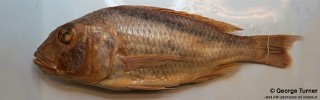
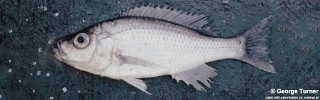
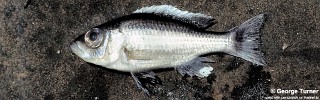

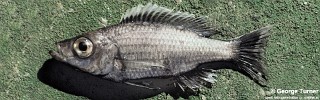



Photo gallery